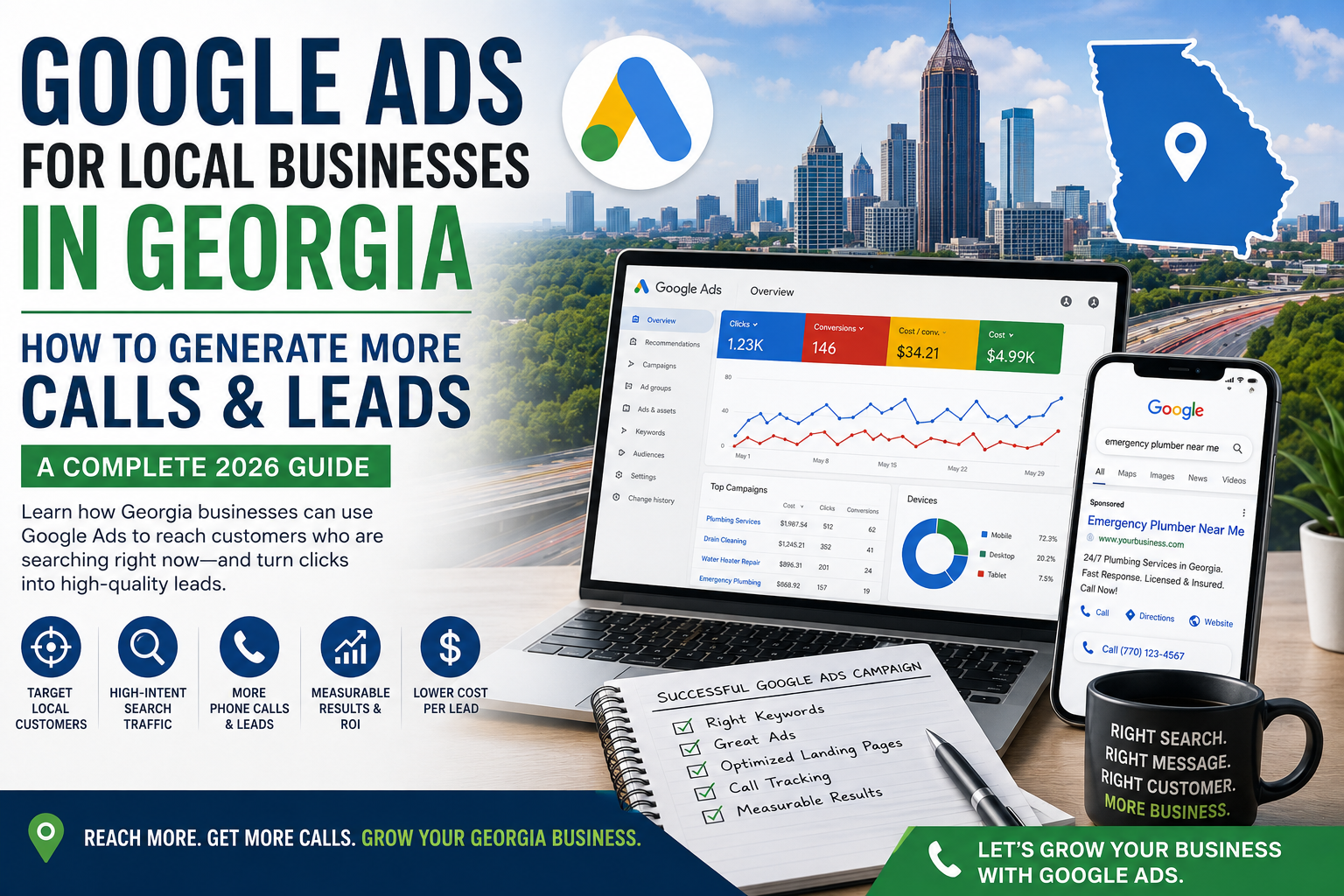
When a potential customer searches Google for a service, they are often much closer to making a purchasing decision than someone casually browsing social media. That's what makes Google Ads such a powerful marketing channel for local businesses.
A homeowner searching “water heater repair near me” isn't researching plumbing for fun. Someone searching “collision repair near me” likely has a vehicle that needs repairs. Someone searching “chiropractor near me” may be actively looking for an appointment. Google Ads gives businesses an opportunity to appear during these high-intent moments.
But simply creating a campaign doesn't guarantee results. Successful Google Ads campaigns require the right keywords, geographic targeting, ad copy, landing pages, bidding strategy, negative keywords, and conversion tracking.
How Google Ads Works
Google Ads operates primarily through an auction. Businesses select keywords and targeting parameters associated with searches they want to reach. When an eligible search occurs, Google determines which ads can appear and their placement using several factors.
Businesses typically pay when someone clicks their advertisement. This is why Google Ads is frequently referred to as PPC, or pay-per-click advertising. The objective isn't to purchase as many clicks as possible. It's to purchase the right clicks.
Search Intent Is Everything
Consider these two searches:
- “how does a water heater work”
- “water heater repair near me”
Both involve water heaters, but the intent is completely different. The first person may simply want information. The second could be looking to hire someone immediately. A good campaign prioritizes keywords associated with commercial intent.
Depending on the business, high-intent terms often contain words such as:
- Near me
- Repair
- Company
- Contractor
- Service
- Estimate
- Emergency
- Appointment
- Installation
- Replacement
Understanding intent can dramatically affect lead quality. Our Google Ads management services focus on high-intent keywords that produce actual customers.
Geographic Targeting for Georgia Businesses
Local businesses shouldn't automatically advertise across the entire state. A plumber based in North Georgia may only want customers within a defined service area. An HVAC company may have specific counties it serves. A collision repair shop may primarily attract customers within a reasonable driving distance.
Campaign targeting should reflect the company's actual service territory. For businesses around Metro Atlanta and North Georgia, that might involve carefully selected communities such as Buford, Cumming, Gainesville, Suwanee, Lawrenceville, Duluth, Flowery Branch, Braselton, Alpharetta, or other relevant markets.
Expanding farther isn't automatically better. The goal is profitable coverage.
Why Negative Keywords Matter
One of the easiest ways to waste money is paying for irrelevant searches. Imagine an HVAC company appearing for:
- “HVAC jobs”
- “HVAC technician salary”
- “DIY AC repair”
Those searches contain relevant industry words, but the people making them may not be potential customers. Negative keywords can prevent ads from appearing for unwanted searches.
Depending on the business, common negative keyword categories can include:
- Jobs
- Careers
- Salary
- Training
- School
- DIY
- Free
- Used
- Wholesale
Negative keyword lists should be customized for each campaign rather than copied blindly.
Your Landing Page Matters
Getting the click is only half the job. What happens after someone clicks? If someone searches for “emergency plumber” and lands on a confusing homepage with no obvious phone number, that expensive click may be wasted.
A strong landing page should reinforce what the customer searched for. It should include:
- Clear headline
- Relevant service information
- Prominent phone number
- Contact form
- Strong call to action
- Reviews
- Trust indicators
- Service area
- Mobile-friendly design
The transition from Google search → advertisement → landing page should feel natural. A well-designed landing page can significantly improve conversion rates and reduce wasted ad spend.
Call Tracking Is Critical for Local Businesses
Many local service businesses receive a significant portion of their leads over the phone. If you're spending thousands of dollars on Google Ads but only measuring contact forms, you may not have an accurate picture of performance.
Call tracking can help determine which marketing efforts generate calls. Combined with form tracking, this gives businesses a much clearer view of lead generation. We implement conversion tracking that connects leads directly to the campaigns that produced them.
Cost Per Lead Matters More Than Cost Per Click
Business owners frequently ask: “How much does a Google click cost?” That's useful information, but it isn't the most important number.
Suppose Campaign A has a $5 average cost per click. Campaign B has a $12 average cost per click. Campaign A sounds better. But what if Campaign A generates one lead for every 30 clicks while Campaign B generates one lead every five clicks? Campaign B could be significantly more profitable despite having more expensive clicks.
That's why businesses should evaluate:
Cost per lead = advertising spend ÷ qualified leads generated
Ultimately, you can take this further and evaluate customer acquisition cost and revenue.
Track Leads Through to Revenue
Imagine spending $2,000 on advertising. The campaign generates 40 qualified leads. Your cost per lead is $50. You close 12 of those leads. Your customer acquisition cost from advertising is approximately $167.
If those 12 customers generate $12,000 in profitable business, you now have much better information for deciding whether to increase, decrease, or restructure the campaign. This is much more useful than simply saying: “We got 400 clicks.”
Common Google Ads Mistakes
Local businesses frequently lose money through:
- Overly broad targeting
- Poor keyword selection
- Missing negative keywords
- Weak landing pages
- No conversion tracking
- Ignoring phone calls
- Sending every visitor to the homepage
- Poor geographic targeting
- Failing to review search terms
- Making major changes without enough data
Google Ads requires active management. Without regular attention, even a well-structured campaign can slowly lose effectiveness.
Should You Run Google Ads Yourself?
Some business owners successfully manage their own advertising. But managing campaigns requires time. You need to understand what customers are searching, analyze search terms, monitor conversions, adjust targeting, evaluate bidding, improve landing pages, and determine whether leads are actually valuable.
The bigger question isn't whether you can manage your own campaign. It's whether doing so is the best use of your time.
Google Ads FAQs
How quickly can Google Ads generate leads?
Campaigns can begin receiving traffic soon after they are approved and active, but performance optimization generally requires data and ongoing adjustments.
How much should a Georgia business spend on Google Ads?
Budgets vary significantly by industry, location, competition, and average customer value.
Can Google Ads target specific Georgia cities?
Yes. Campaigns can use geographic targeting to focus advertising around the areas relevant to a business.
Is Google Ads better than SEO?
They serve different purposes. Google Ads can generate immediate paid visibility while SEO aims to build long-term organic visibility. Many businesses benefit from using both.
Can Google Ads track phone calls?
Yes. Proper tracking can help businesses understand when advertising generates phone calls and other conversions.
Google Ads Management for Georgia Businesses
At Go Digital GA, we help Georgia businesses build advertising campaigns focused on generating measurable leads rather than meaningless traffic. We focus on connecting advertising with the rest of your digital presence, including landing pages, websites, conversion tracking, SEO, and local visibility.
The goal isn't to get you more clicks. The goal is to help you get more customers. Contact Go Digital GA to discuss Google Ads management for your Georgia business.
Schedule a Free Strategy Call